Many use AI, few design how people and AI work together
 René Hoyer
3 min read
In most organizations AI arrived long ago, only nobody introduced it. Around 60 percent of employees deliberately use AI at work, according to a Melbourne Business School study that Deloitte cites in its 2026 Global Human Capital Trends. In the same report, only 14 percent of leaders say they are adept at shaping how humans and AI interact.
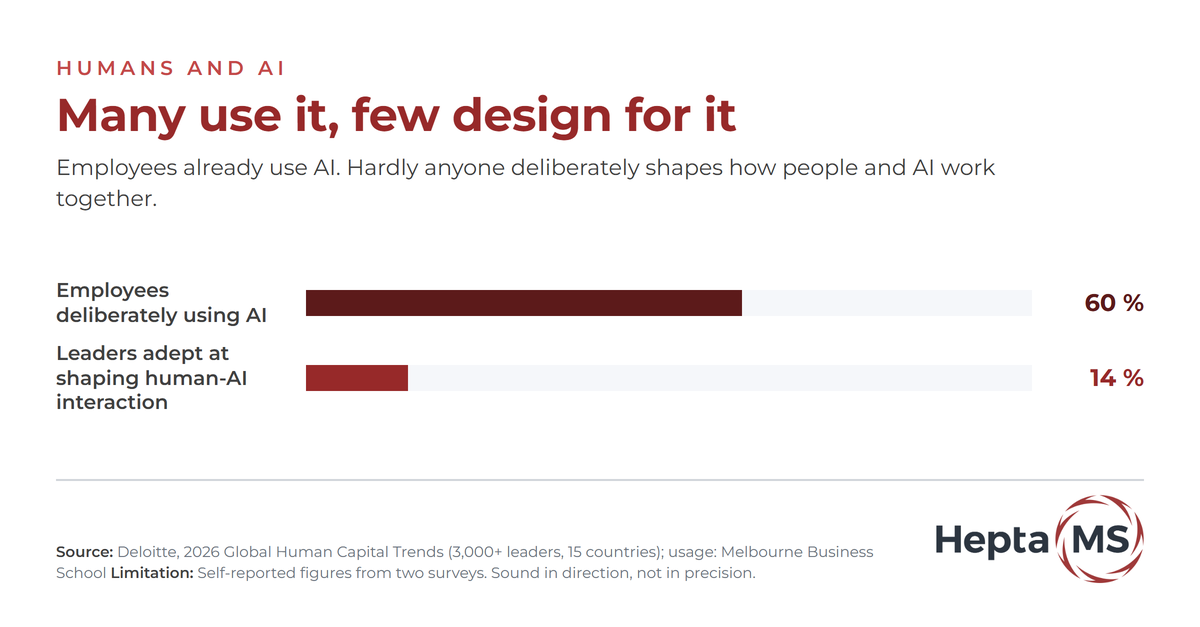
The 14 percent comes from the main survey of more than 3,000 leaders in 15 countries. Both values are self-reported and come from different surveys, so the exact gap is not precise. The direction is.
Use from the bottom up, design stays absent
Deloitte describes the pattern like this: organizations design relationships between people, and increasingly between machines. The work itself they still plan separately, once for people and once for technology, rather than for both together.
Day to day this looks harmless. Someone has a contract draft pre-written, someone else has an analysis built, a team lets an agent pre-sort tickets. Each step makes sense on its own. Together they shift who actually decides. The check that used to sit in a four-eyes conversation now sits with the person who wrote the prompt, and that person often does not know they have taken on the role.
This is the part of AI that shows up on no dashboard. Teams feel faster. Whether the organization still knows who is accountable for what, nobody measures.
Why this is a leadership task
Use cannot be ordered or banned, it simply happens. Design, by contrast, does not happen by itself. It needs decisions only leadership can make:
- Which work stays with a person, even where a machine could do it?
- Who checks results a machine produces, and how deeply?
- Who may decide that an agent gets access to real systems?
- How do we get back when something goes wrong?
As long as these questions stay open, everyone answers them alone. The result is not chaos but something quieter: an organization that produces faster and notices later when something goes wrong.
Designing means filling roles
Design becomes tangible once it is clear who answers which question. In HeptaMS a triad of three roles takes this on. The Value Owner decides what creates value next and what waits, even when a machine could deliver both equally fast. The Flow Owner owns the cadence and sees where review and approval pile up. The Architecture Owner keeps technical soundness in view, including what an agent may touch.
These three roles exist at team, domain and portfolio level, with the same cut at a different altitude. They do not replace a tool decision. They make sure the questions above belong to someone.
A good start is a sober stocktake: where do teams already use AI today, and who decided there that this is fine? Where the second question has no answer, the design work begins.
A free introduction to the method is HeptaMS Explained. What Lean-AI means for leadership is set out on Lean-AI for leaders.
Sources: Deloitte, 2026 Global Human Capital Trends, chapter "Getting human and machine relationships right"; Melbourne Business School, cited there. Method: more than 3,000 leaders in 15 countries, with Oxford Economics.
Frequently asked questions
Where do the 60 and 14 percent come from?
The 14 percent from the main survey of Deloitte's 2026 Global Human Capital Trends, with more than 3,000 leaders in 15 countries. The roughly 60 percent from a Melbourne Business School study cited by Deloitte.
What does it mean to design how people and AI work together?
Deciding which work a person does, which a machine does, who checks results and who decides. So far, work is mostly planned separately for people and for technology.