The hardest questions were rarely about the code
 Frank Wiechers
4 min read
The agent builds what's written
Coding agents, AI tools that write software, now build in hours what used to take a team weeks. They build what the requirement says. Not what was meant.
A single sentence used to be enough for a requirement. The team asked questions and closed the gaps in conversation. An agent doesn't have that conversation. Where answers are missing, it makes assumptions and implements them consistently.
An example
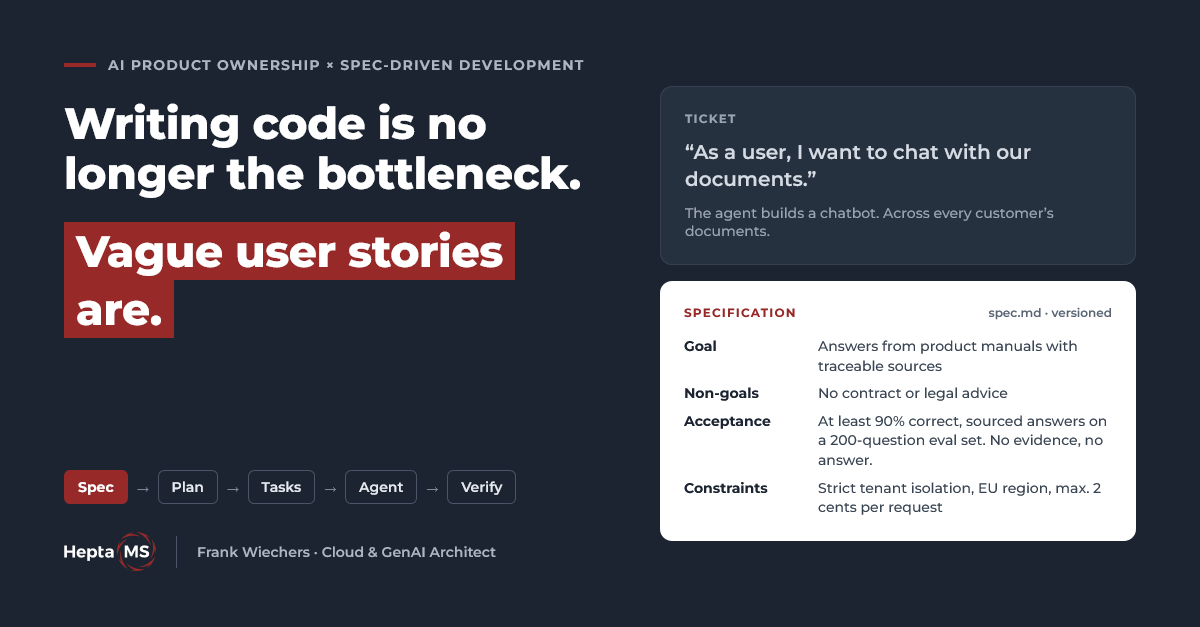
The requirement reads: "As a user, I want to chat with our documents."
An experienced team would ask: Which documents? For whom? What may the chatbot answer, and what not?
The agent doesn't ask. It builds a chatbot that works, but it doesn't distinguish which customer a document belongs to. Some answers come from another customer's files. Technically everything runs. From a business point of view, it's a data breach.
The same requirement, precisely described
| Question | Decision |
|---|---|
| What is the goal? | Answers from product manuals, each with its source |
| What is out of scope? | No contractual or legal advice |
| How do we measure success? | At least 90 % of 200 test questions answered correctly and with a source |
| Which constraints apply? | Customers see only their own data, storage in the EU, cost cap per request |
A description like this is called a spec, and the method behind it spec-driven development. A spec is a set of decisions that have to be made before implementation, which makes it more than a technical detail. Software can be regenerated. Whether the right thing was built is decided by the spec.
From practice
I tried this myself: an AI application that answers questions about business documents and serves several customers strictly separated. After a few days it was in production. Technical questions never held me up.
Three principles were fixed before the first line of code:
- Customers see only their own data. Automated tests check this.
- Answers only from the documents, always with a source. If the system doesn't know something, it says so.
- Data stays in the EU and can be deleted completely.
Success was defined up front as well: real sample documents with questions whose correct answer was known, such as a specific invoice amount.
The technical implementation changed several times along the way, for example for document uploads. The plan was for files to go straight from the browser into cloud storage, bypassing the application. That's a common approach. Here it kept causing errors because browser and storage clashed over security rules. I needed three fixes for the same problem.
What finally solved it was a question of principle: do we even want files to reach storage without passing through our application? The answer was no. Since then, every upload goes through the application, which checks who uploads what. That was a security decision, not a programming question. Three fixes in the same place usually mean a decision is missing. The three principles stayed the same throughout.
Questions before the start
- Who are the users, and what must never happen?
- When may the system reuse an earlier answer? It sounds technical, but it's a business question: treat similar questions as identical too quickly and someone gets the wrong total.
- What does the system say when it doesn't know something?
- What may it cost?
- What are we deliberately not building?
- How do I know it's right?
What this means for product ownership
- Define what the system should not do.
- Make success measurable. "Good answers" is not a criterion.
- Write security, data protection and cost into the requirement instead of checking them at the end.
- Define what must hold, not how it is implemented.
- When something changes, update the requirement first, then the software.
In HeptaMS, this work belongs to the Value Owner, who decides what gets built and what is deliberately left out. The how belongs to the team, and these days to the agent as well.
When software appears in minutes, clarity about what to build becomes the bottleneck. Product ownership starts before the agent does.
Who writes the specs on the team? The product owner, the developers, or honestly nobody? And if nobody: which assumption by the agent has been the most expensive so far?
Frequently asked questions
What is spec-driven development?
A way of working where a versioned specification comes before implementation, covering goal, exclusions, acceptance criteria and constraints. The plan, the tasks and the agent's work are derived from it and checked against it.
What belongs in a spec and what doesn't?
What must hold belongs in it, such as data separation, mandatory sources, cost limits and measurable success criteria. How it is implemented technically does not.
How do you spot a missing decision?
The same spot keeps needing fixes. In the example it took three fixes to the upload. What solved it was asking whether files should reach storage without passing through the application at all.