
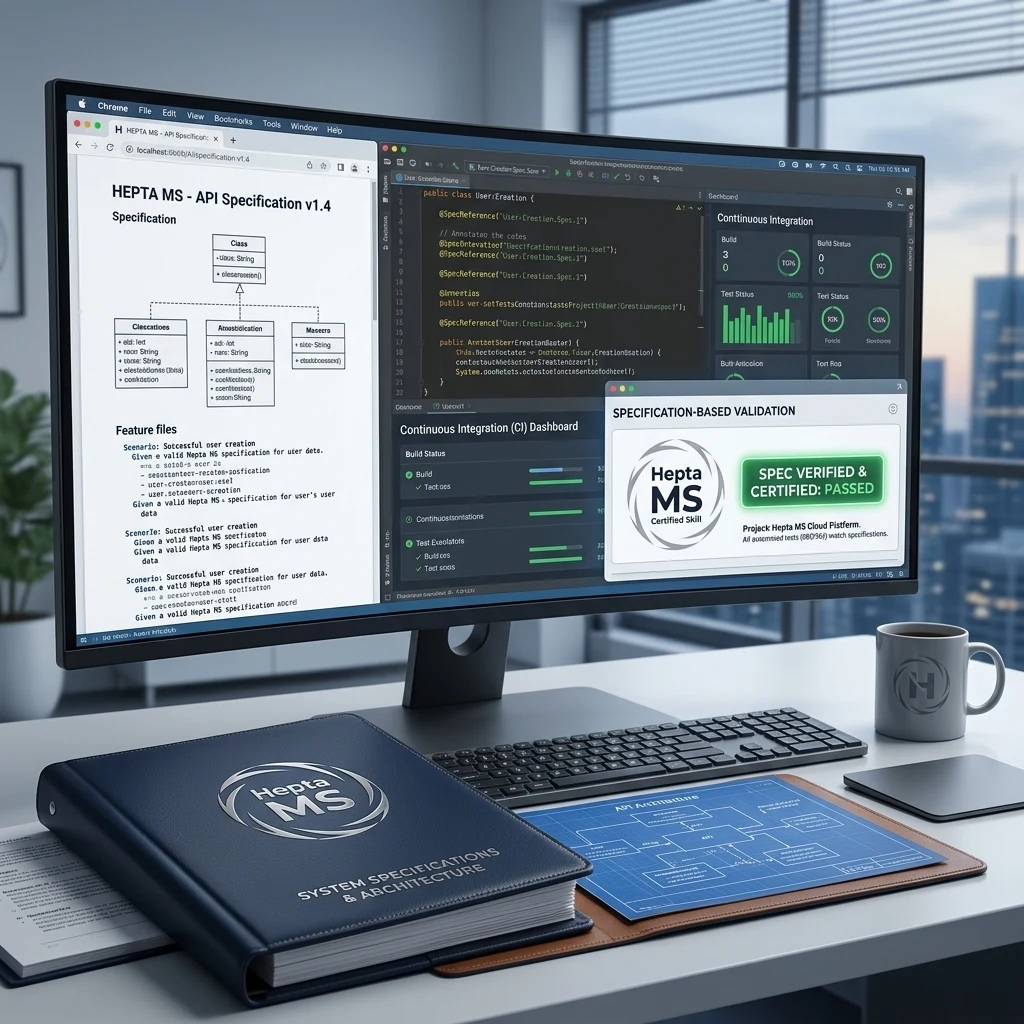
HeptaMS Spec Driven Development
Leads to certification: HeptaMS Certified Skill – Spec Driven Development
The course covers spec-driven development: the specification as the leading artefact and the path from the constitution through specification, plan and tasks to delivery by an agent.
- Scope
- 4 half-days of 4 h (~16 h) – theory alternating with practical work 4 blocks of 4 hours
- Formats
- Live Online · In person
- Exam
- Multiple choice, 10–15 questions, 70 %, 3 attempts · optional practical submission (specification plus result from day 2)
- Prerequisites
- Development experience. S4 AI Coding foundation strongly recommended; isolation, secrets and token budget are assumed.
What it covers
The course covers spec-driven development: the specification as the leading artefact and the path from the constitution through specification, plan and tasks to delivery by an agent. It covers the reasons why AI-generated code can be faulty, how faulty corrections spread, and where spec-driven development falls back into up-front planning. A practical part runs the workflow against a set of tasks in a prepared environment, followed by work with error classes and knowledge sources.
When an agent implements a feature overnight, delivery is no longer the scarce resource; clarity about what should be built is. AI does not make development uniformly faster but increases the spread of outcomes.
What you can do afterwards
- Explain why AI increases the spread of development outcomes.
- Check a requirement for whether it is unambiguous, bounded and testable.
- Distinguish augmented coding from vibe coding.
- Name the mechanisms by which AI-generated code goes wrong, and find such a fault in a patch.
- Write a constitution and a specification that steer an agent reliably.
- Run the workflow through and verify the result against the specification.
- Recognise when spec-driven development falls back into up-front planning, and counteract it.
- Identify an error class and assign it to the correct knowledge source.
Who this course is for
Developers who work with coding agents and want better results. Tech leads who have to establish a way of working for their team. Architects.
Anyone growing into an architecture or tech lead role. Requirements engineers and business analysts with a technical background. QA roles who have to ensure testability.
Learning objectives in detail
- 1 Explain why AI increases the variance of development rather than accelerating it uniformly, and what follows for ways of working.
- 2 Check a requirement at the quality gate – unambiguous, bounded, testable – and explain why an unclear requirement costs more with an agent than with a person.
- 3 Distinguish augmented coding from vibe coding and determine from their own approach which is happening.
- 4 Name the five mechanisms by which AI-generated code goes subtly wrong, and find such a fault in a patch.
- 5 Write a constitution and a specification that steer an agent reliably.
- 6 Run the SDD workflow – specify, plan, tasks, implement – and verify the result against the specification.
- 7 Recognise when SDD falls back into a waterfall and apply the three remedies: limited batch size, verification before and after delivery, empirical control.
- 8 Identify an error class and assign it to the right knowledge source: constitution, spec template or architecture decision log.
Dates & demand pools
No date yet - express interest in a demand pool and we will set one when enough peers join.
No date that fits? Express non-binding interest in a demand pool - once enough peers join, we set a date and place and get in touch.
Name your preferred date and start a pool for this course. Once enough people join we schedule it and get in touch – you only book after that.
Is this course right for your situation?
If no date fits or you need the course in-house: drop us a line and we will come back with a proposal.