
HeptaMS Lean-AI Delegation and Leadership
Leads to certification: HeptaMS Certified Skill – Lean-AI Delegation and Leadership
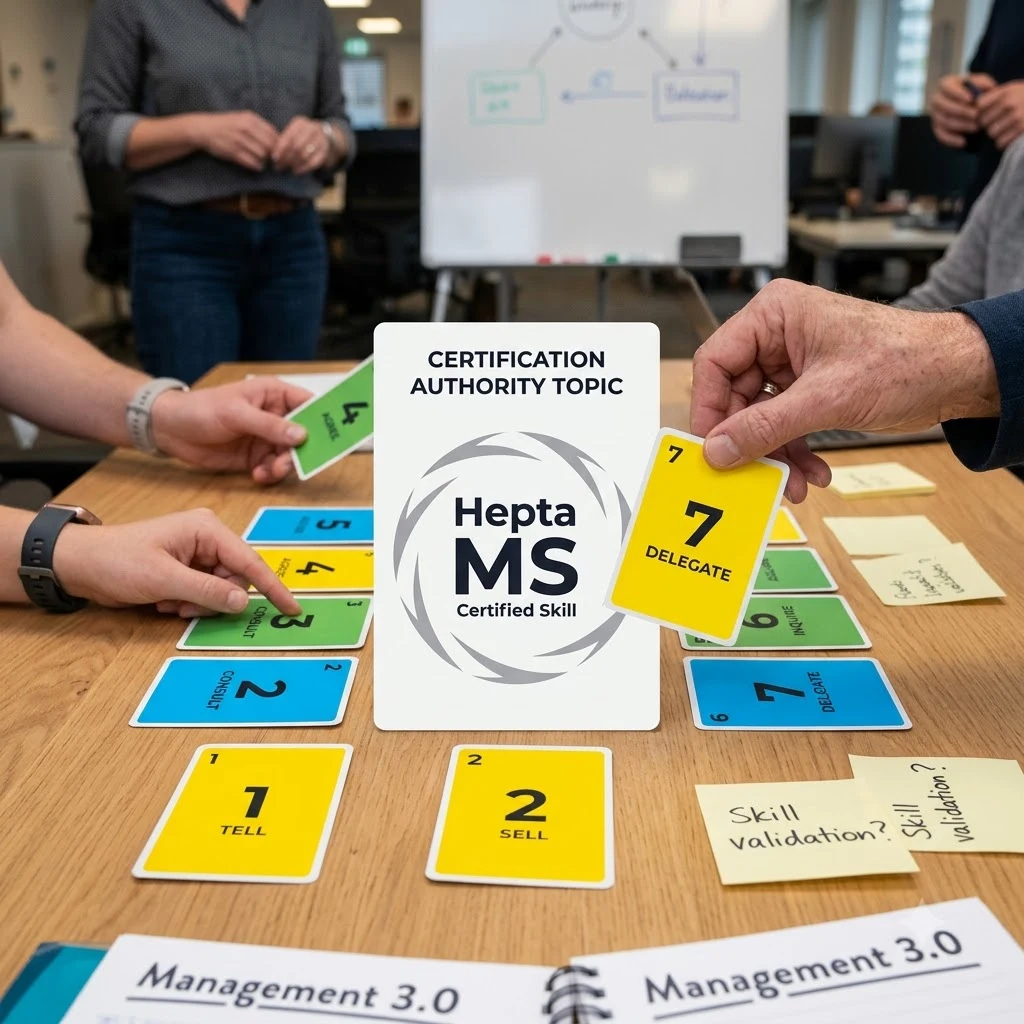
The course covers leadership in knowledge work: the view of people behind leadership decisions, situational leadership, the seven levels of delegation and the delegation board as a tool.
- Scope
- 2 half-days of 4 h (~8 h) 2 blocks of 4 hours
- Formats
- Live Online
- Exam
- Multiple choice, 10–15 questions, 70 % to pass, 3 attempts included
- Prerequisites
- none. Leadership experience or an own team makes the course considerably more effective.
What it covers
The course covers leadership in knowledge work: the view of people behind leadership decisions, situational leadership, the seven levels of delegation and the delegation board as a tool. Further topics are motivation, psychological safety and feedback culture. A dedicated part transfers the delegation logic to working with coding agents and covers why the burden of decision-making changes under AI conditions.
Delegation is usually thought of as binary: either the leader decides or the team does. At the delegation board it regularly emerges that leaders assume more delegation than actually takes place, while teams perceive less latitude than they are granted.
What you can do afterwards
- Recognise from the behaviour and the rules of an organisation which view of people lies behind them.
- Determine and justify the appropriate delegation level for a concrete decision.
- Create a delegation board for your own team and align it with the team.
- Create a delegation board for working with coding agents and establish what runs autonomously and where checks apply.
- Distinguish decisions that belong centrally from those that belong locally.
- Check whether psychological safety is present in your own team.
Who this course is for
Leaders in IT: team leads, engineering managers, first-time leaders, department heads. Everyone who has to distribute decisions and is unsure how far.
Experienced developers moving towards a leadership role. Flow owners and scrum masters who have to be effective without line authority. Anyone leading a team of people and agents.
Learning objectives in detail
- 1 Recognise from behaviour and rules which view of people underlies an organisation (Theory X / Theory Y) and what that means for their own practice.
- 2 Determine and justify the appropriate delegation level for a concrete decision.
- 3 Create a delegation board for their own team and align it with the team via delegation poker.
- 4 Create a delegation board for working with coding agents and name which work may run autonomously and where a check remains mandatory.
- 5 Tell delegation level and action boundary apart: leadership decision versus technical enforcement.
- 6 Distinguish central from local decisions and explain why every hierarchy level adds waiting time.
- 7 Check whether psychological safety is present in their team and recognise the four survival strategies in a team's silence.
- 8 Explain why decentralisation is no longer a maturity question under AI conditions.
Dates & demand pools
No date yet - express interest in a demand pool and we will set one when enough peers join.
No date that fits? Express non-binding interest in a demand pool - once enough peers join, we set a date and place and get in touch.
Name your preferred date and start a pool for this course. Once enough people join we schedule it and get in touch – you only book after that.
Is this course right for your situation?
If no date fits or you need the course in-house: drop us a line and we will come back with a proposal.