
HeptaMS Requirements Engineering and Product Design (Lean-AI)
Leads to certification: HeptaMS Certified Skill – Requirements Engineering and Product Design
The course covers business-side requirements work in four steps: understanding need, writing requirements, cutting scope and verifying the result.
- Scope
- 3 half-days of 4 h (~12 h) 3 blocks of 4 hours
- Formats
- Live Online
- Exam
- Multiple choice, 10–15 questions, 70 % to pass, 3 attempts included
- Prerequisites
- none. Experience in a product or requirements context makes the exercises more productive.
What it covers
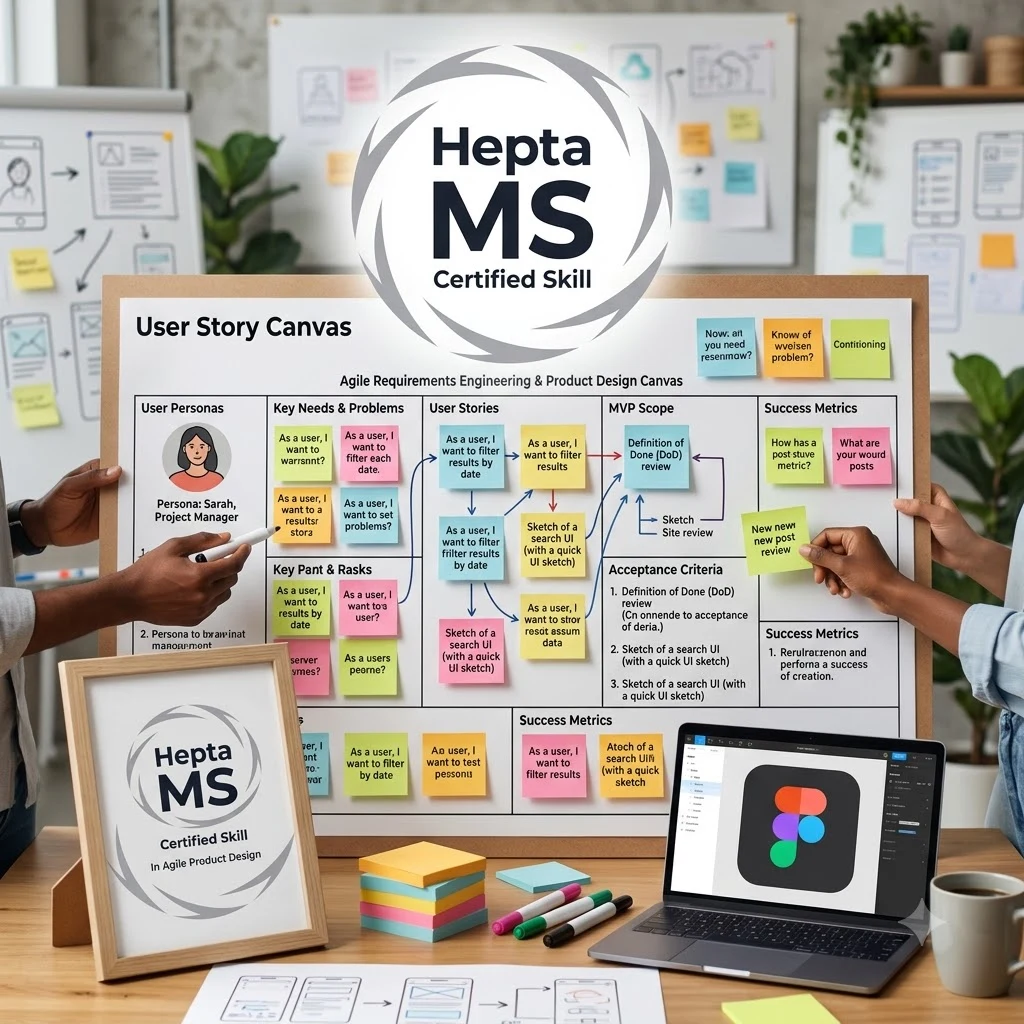
The course covers business-side requirements work in four steps: understanding need, writing requirements, cutting scope and verifying the result. Topics include product vision and customer needs, personas and jobs-to-be-done, the story format and INVEST, story splitting and story mapping, MVP scope, sketches and prototypes, as well as acceptance criteria, user testing and success metrics. A dedicated part covers how a requirement differs when it will be implemented by an agent.
The user story emerged as a conversation trigger: it leaves gaps open that are clarified in conversation. An agent holds no conversation and makes assumptions instead. At the same time the older question remains of whether the right thing is being built, since approval in a review and use in daily work are different signals.
What you can do afterwards
- Derive a persona and a job-to-be-done from observed need.
- Choose the appropriate kind of backlog item instead of phrasing everything as a story.
- Write and check requirements against INVEST and recognise typical malformed patterns.
- Split an oversized requirement in several ways and explain why a horizontal cut rarely holds.
- Create a story map and derive an MVP scope from it that makes a named assumption testable.
- Prepare the same requirement for a team and for an agent.
- Tell acceptance criteria, definition of done and success metrics apart.
- Set up a review so that product feedback emerges, and choose the appropriate feedback method.
Who this course is for
Value owners and product owners. Business analysts and requirements engineers. Product managers.
Anyone growing into a product or requirements role. UX roles working with delivery teams. Business representatives who formulate requirements. Developers who want to understand why they receive what they receive.
Learning objectives in detail
- 1 Explain why "card, conversation, confirmation" no longer holds with an agent and what follows for requirements work.
- 2 Derive a persona and a job-to-be-done from observed need rather than inventing them.
- 3 Choose the appropriate backlog item type – story, epic, spike, task, bug or enabler – instead of forcing everything into stories.
- 4 Write and check requirements against INVEST and recognise the typical anti-patterns.
- 5 Split an oversized requirement in at least two ways and explain why a horizontal cut is usually wrong.
- 6 Create a story map and derive from it an MVP scope that makes a named hypothesis testable.
- 7 Prepare the same requirement for a team and for an agent and justify the difference.
- 8 Tell acceptance criteria, definition of done and success metrics apart and formulate them for an MVP.
- 9 Set up a review so that it produces product feedback and name who has to be present.
- 10 Choose the appropriate feedback method – observation, analytics or A/B test – and name its data protection limits.
Dates & demand pools
No date yet - express interest in a demand pool and we will set one when enough peers join.
No date that fits? Express non-binding interest in a demand pool - once enough peers join, we set a date and place and get in touch.
Name your preferred date and start a pool for this course. Once enough people join we schedule it and get in touch – you only book after that.
Is this course right for your situation?
If no date fits or you need the course in-house: drop us a line and we will come back with a proposal.